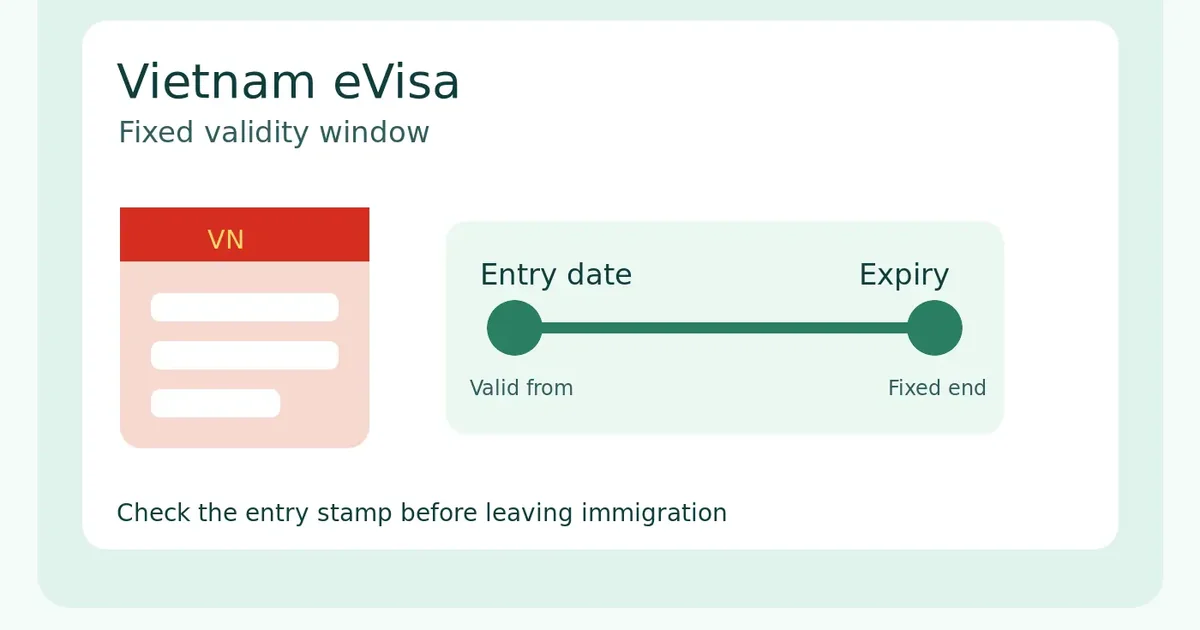
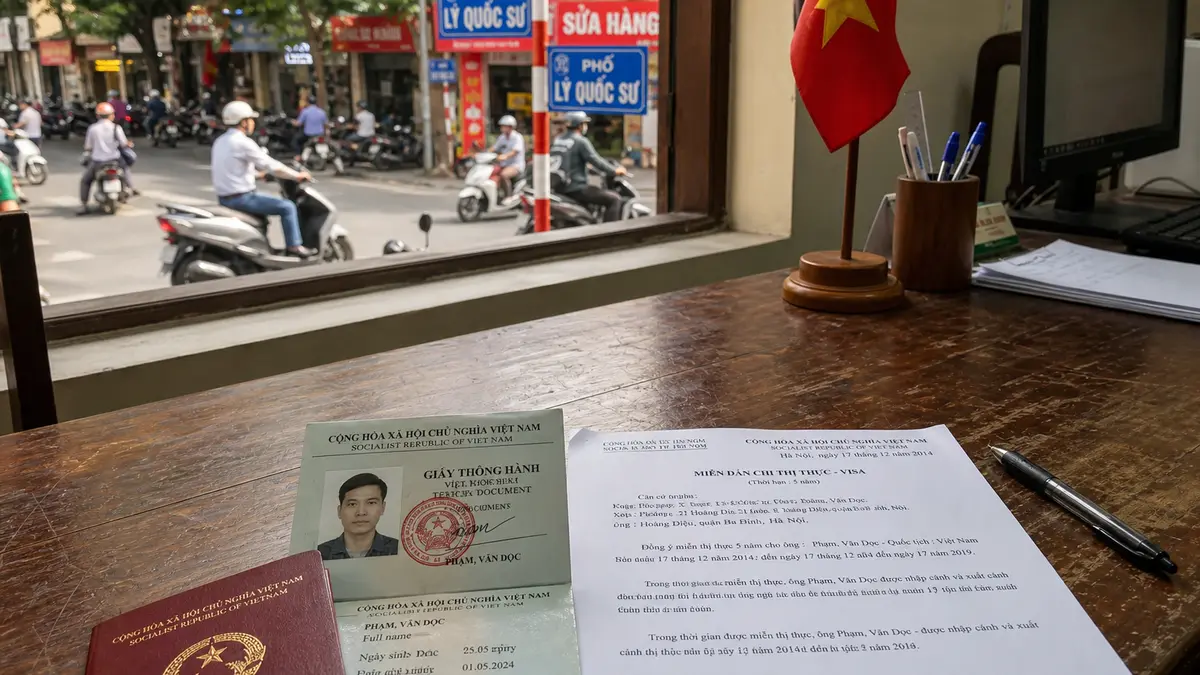
TL;DR: A Vietnam eVisa is a fixed date window, not a movable "90 days after arrival" counter. You may enter only within the validity period shown on the visa, entering late does not push the end date forward, and a multiple-entry eVisa still uses the same window for every entry. After arrival, check the entry stamp or temporary stay record before leaving the border area.
Quick Answers
| Question | Practical answer |
|---|---|
| When does my stay start? | From the day you actually enter Vietnam. |
| Does late entry extend the visa? | No. The visa expiry date stays fixed. |
| Which date should I follow? | Use the earlier of the eVisa expiry date and the leave-by date shown by immigration. |
| Does a multiple-entry eVisa reset the 90 days? | No. Every entry must fit inside the same validity window. |
| Is visa-free entry calculated the same way? | No. Visa-free entry is a separate rule, but the arrival stamp still controls the practical leave-by date. |
The eVisa Is a Fixed Window
The Vietnam eVisa application asks for planned dates, but the approved eVisa is issued with a fixed validity period. The important result is the "valid from" date and the "to" or expiry date shown on the visa.
That means you cannot arrive before the start date. You can arrive later within the approved window, but the expiry date does not move. If your visa is valid from August 1 to October 29 and you arrive on August 10, you do not receive a new 90-day stay ending in November.
What the 90-Day Limit Means
Vietnam's eVisa system allows a maximum validity of 90 days, for single or multiple entries. This is a maximum, not a guarantee that every application will receive the longest possible period, and it is not a fresh 90 days each time you re-enter.
If your travel plan may change, request a validity window that covers the earliest realistic arrival date and the latest realistic departure date, while staying inside the official maximum. The U.S. travel advisory warns that eVisas may be issued only for the period requested in the application, so applying for a tight window can create overstay risk if plans slip.
Once you arrive, the conservative rule is simple: leave by the earlier date between the eVisa expiry and the date given by immigration on your entry stamp or temporary stay record. If those dates do not match, ask immigration before leaving the border area.
Three Common Examples
On-time entry. Your eVisa is valid from August 1 to October 29. You enter on August 1. Your planned stay can run through October 29, subject to the date immigration gives you at entry.
Late entry. The same eVisa is valid from August 1 to October 29, but you enter on August 10. The end date remains October 29. The unused days at the start are lost.
Multiple entry. Your multiple-entry eVisa is valid from August 1 to October 29. You enter on August 1, leave on August 20, re-enter on September 10, and re-enter again on October 20. All entries and the final exit must still fit inside the same August 1 to October 29 window.
Single Entry vs Multiple Entry
A single-entry eVisa is normally consumed after one entry. If you leave Vietnam, you cannot use the same single-entry eVisa to enter again, even if the expiry date has not arrived.
A multiple-entry eVisa lets you leave and re-enter during the approved period. It does not extend the final expiry date, and it does not create a new stay allowance at each re-entry.
Visa-Free Entry Is Different
Do not mix eVisa counting with visa-free counting. Vietnam has separate visa-free rules, including 45-day policies for certain passports and purposes. For example, Resolution 44/NQ-CP covers citizens of 12 countries from March 15, 2025 through March 14, 2028, and Resolution 229/NQ-CP adds a separate tourism-stimulus exemption for another group of European countries from August 15, 2025 through August 14, 2028.
Those are not eVisa rules. If you enter visa-free, count from the arrival date and check the entry stamp immediately. For the full country list and eligibility notes, use the separate visa-exemption guide rather than this eVisa stay-duration article.
Applying for a New eVisa While in Vietnam
If you obtain a new eVisa while already in Vietnam, do not assume it extends your current stay inside the country. GOV.UK states that if you get an eVisa while in Vietnam, you must exit and re-enter for that eVisa to start.
This makes border timing important. A new approval in your email does not by itself replace the leave-by date from your current entry.
Practical Checklist
- Use
evisa.gov.vnas the official eVisa portal. - Request a validity window that includes realistic buffer at both ends.
- Do not enter before the eVisa start date.
- Do not assume late arrival extends the expiry date.
- Print or save the approved eVisa and compare it with your passport details.
- At entry, check the stamp or temporary stay date before leaving immigration.
- Avoid flights that complete exit formalities after midnight on the last permitted day.
References
- Vietnam Tourism: Resolution 44/NQ-CP visa exemption for citizens of 12 countries
- Vietnam Tourism: Resolution 229/NQ-CP visa exemption policies effective from 15 August 2025
- Vietnam National Electronic Visa System FAQ: eVisa validity
- Vietnam National Electronic Visa system
- Vietnam Government News: eVisas for all foreign arrivals from August 15, 2023
- GOV.UK: Vietnam entry requirements
- GOV.UK: Living in Vietnam
- U.S. Department of State: Vietnam international travel information