Disclaimer: The information in this article is compiled by evisaflow.com from official publications and open internet sources for informational purposes only, and does not constitute formal travel advice. Travel information (including but not limited to visa regulations, entry policies, fees, and attraction schedules) is subject to change without notice. Please verify all details independently with the relevant official authorities before traveling. evisaflow.com assumes no liability for travel disruptions or losses resulting from reliance on this content.
Guide
Long-stay & Expat
Visa Application
7 min read
Destination Thailand Visa (DTV) Guide: Requirements, Fees, and How to Apply
Official requirements, fees, and steps for the 5-year multiple-entry Destination Thailand Visa (DTV) for remote workers, soft-power participants, and eligible dependents.

TL;DR: The Destination Thailand Visa (DTV) is a 5-year multiple-entry visa for remote workers, digital nomads, soft-power participants, and eligible spouses or children under 20. It allows stays of up to 180 days per entry, requires financial evidence of at least THB 500,000, and can only be applied for while outside Thailand through the official Thai e-Visa system.
Quick Facts
| Visa Detail | Rule & Requirement | Official Entry / Action |
|---|---|---|
| Visa Fee | MFA base fee: THB 10,000; pay the non-refundable amount published by the mission handling your application in its accepted currency | Paid online via Thai e-Visa Portal |
| Stay Limit | Up to 180 days per entry (multiple entry, valid for 5 years) | Each later entry is subject to immigration inspection; one in-country extension of up to 180 days may be requested |
| Financial Proof | Evidence of at least THB 500,000; the required statement period and whether sponsorship is accepted vary by mission | Check the current checklist of the mission processing the application |
| Application Location | Must be outside Thailand at time of submission | Apply online through the embassy or consulate responsible for your current location |
| Tax Residency | Generally resident if staying 180 days or more in a calendar year | Tax treatment depends on when income was earned, when it was remitted, treaty relief, and other facts |
DTV Categories & Requirements
Applicants must select the correct track when applying. The requirements vary based on the chosen category.
For every DTV category, the official page also lists a passport or travel-document biodata page, a photograph taken within the last six months, a document showing the applicant's current location, and financial evidence of at least THB 500,000. The category-specific evidence below is required in addition to those common documents.
1. Remote Work (Workcation)
For digital nomads, remote employees, and freelancers.
- Workcation evidence: A valid employment contract, certificate of employment, or professional portfolio showing remote-worker, digital-nomad, foreign-talent, or freelancer status.
2. Soft Power Activities
For travelers participating in an eligible Thai soft-power activity or receiving medical treatment.
- Activity evidence: Confirmation that you will attend the activity listed in your application.
- Medical evidence: An appointment letter from a hospital or medical center in Thailand.
3. Dependents of DTV Holders
For the spouse and children under 20 of a DTV holder.
- Relationship evidence: A copy of the DTV holder's visa plus a marriage certificate, birth certificate, adoption certificate, or other accepted proof of relationship.
The THB 500,000 Financial Evidence Requirement
Financial evidence is a core DTV requirement, but Thai missions may request different supporting documents.
- The official DTV page requires financial evidence of at least THB 500,000 and gives bank statements or a sponsorship letter as examples.
- Check the document checklist of the embassy or consulate processing your application before submission. Missions set their own statement-period, balance-format, sponsorship, currency, and additional-document requirements.
How to Apply for DTV Online
Prepare the common documents and the evidence for your category above before starting. The following steps follow the official Thai e-Visa user manual; the document checklist for your application comes from the mission handling it.
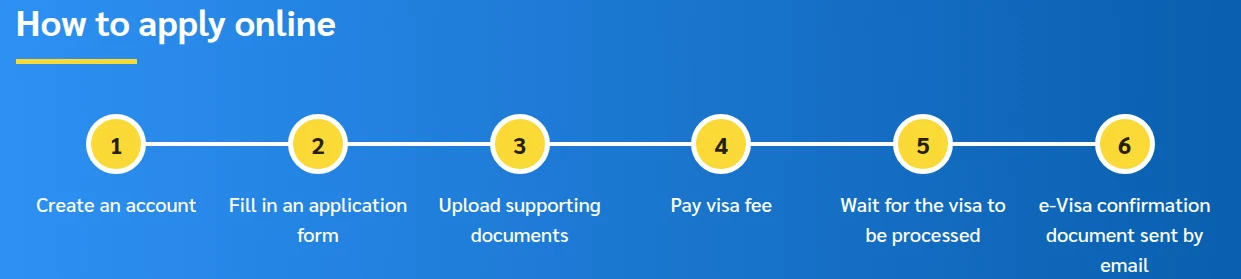
1. Create and activate your account
Open Thai e-Visa, choose Create Account, and register as an individual. Enter your details and an email address you can access, then activate the account using the verification email. Check your spam folder if it does not arrive. Sign in and choose Apply for new visa.
2. Select your location, mission, and DTV category
Enter your travel-document nationality and your actual permanent residence/current location. Check the embassy or consulate under Submit to before continuing. You must apply from outside Thailand; do not choose a different location just to obtain another mission's fee or checklist. Select the DTV purpose matching your evidence: workcation, a qualifying activity, or an eligible family relationship.
3. Complete the form and upload the documents
Fill in the applicant, passport, address, employment, and travel information. Upload the passport biodata page, recent photo, and supporting files requested for your category. Open each file before uploading to check that it is readable, complete, and belongs to the correct applicant. Keep current-location evidence separate from your planned Thai accommodation details.
4. Review the application and pay
Use Manage Application to review the saved application. Correct errors before proceeding from Ready to Submit to payment. Compare names, passport number, dates, category, and receiving mission with your documents. Confirm the amount and currency shown for that mission, pay through the official flow, and save the receipt. Payment is not visa approval.
5. Follow the application and any requests
Use Check Status and monitor your registered email. The mission may request additional documents or an interview; respond through the channel and by the deadline it specifies. For an unclear request or a delay, contact the mission processing your application. Use its published processing guidance when planning travel rather than assuming a universal DTV turnaround time.
6. Save and check the issued visa
After approval, save the e-Visa confirmation sent by email or the visa document available in your account. Check the personal details and validity dates, and print a copy for the airline and immigration. If something is wrong, contact the issuing mission before travel; a payment receipt is not the issued visa.
Common Pitfalls and Application Errors
The DTV application fee is non-refundable. Review the official checklist for the mission processing your application before paying.
Passport Name and Data Mismatches
Your application details should match your passport and supporting documents. Official e-Visa guidance warns that simple errors in a name or passport number can lead to rejection, and the embassy cannot edit personal details for the applicant. Incorrect details may also cause difficulty at immigration.
Before paying the application fee, compare the application name, passport number, date of birth, and uploaded document details against the passport.
In-Country Extensions vs. Later Entries
Each admission on a DTV may allow a stay of up to 180 days. For travel planning, distinguish an in-country extension from leaving Thailand and later seeking a new admission:
- In-Country Extension: You can request one extension of up to 180 days for an individual stay. Confirm the current fee and supporting-document requirements with the immigration office where you will apply.
- Leave and Re-enter: A valid multiple-entry DTV can be used for a later entry, but each admission remains subject to immigration inspection. The visa does not itself guarantee admission on a later entry.
Tax Residency Rules
The Revenue Department treats income from work performed or business carried on in Thailand as Thai-sourced income, whether it is paid inside or outside Thailand. If you spend 180 days or more in Thailand within a calendar year, you are generally treated as a Thai tax resident regardless of visa type. Foreign-sourced income earned from January 1, 2024 onward may be assessable when remitted to Thailand if the person was a Thai tax resident in the year it was earned. The Revenue Department states that foreign-sourced income earned before January 1, 2024 and remitted later is not subject to this rule. Double-tax treaties, foreign tax credits, exemptions, and individual facts can change the result. Keep records of entry dates, where work was performed, income years, remittances, and foreign tax paid, and obtain professional advice for your circumstances.
References
- Official Thai E-Visa Portal: Official Application Portal
- Official Destination Thailand Visa requirements: DTV Visa
- Thai Ministry of Foreign Affairs summary of the fee, validity, stay period, and extension: Thailand New Visa Measures
- Ministry of Foreign Affairs of Thailand: Consular Department Portal
- Department of Consular Affairs — e-Visa applications from outside Thailand: Thai e-Visa: Apply Anywhere, Anytime
- Official e-Visa guidance on application errors: Common Mistakes in Applying for Thai e-Visa
- Example of a current mission-specific DTV fee and checklist: Royal Thai Embassy, Washington D.C. — DTV
- Thai Revenue Department guide to foreign-sourced income: Foreigners Pay Tax 2024
- Thai e-Visa — User Manual (English)
eVisaFlow tool
Filling official eVisa and arrival forms?
eVisaFlow helps you reuse passport details and reduce repetitive typing when you complete supported Southeast Asia eVisa and arrival forms.
Related Reading

Guide
Staying in Thailand Long-Term: Comparing LTR and DTV Visa Options
Compare Thailand's 10-year Long-Term Resident (LTR) visa and the 5-year Destination Thailand Visa (DTV) by requirements, fees, tax rules, and benefits.
News
Thailand Entry Requirements and TDAC Guide: Visa-Free Rules and Registration
Check Thailand's visa-exemption rules, TDAC timing, and entry documents before you travel.
Guide
Southeast Asia Visa Run Guide: Land Borders, Entry Limits, Safer Options
Check Thailand's September 2026 visa-exemption rules, repeat-entry limits, and eVisa ports for Vietnam, Cambodia, and Laos before a visa run.

Guide
Malaysia MM2H Visa Guide: Silver, Gold, Platinum Rules & Requirements
Review Malaysia My Second Home (MM2H) tier rules, fixed deposit tiers, mandatory property purchase rules, and application steps.